Understanding the Philosophical Code Through C++ Features
The Code:
#include<iostream>
#include<string>

template<typename T>
class Energy {
public:
    Energy() = default;

    Energy(const T &e) : energy{e} {

    }

    T& E()  {
        return energy;
    }

    int procCommand(const T &s) {
        if(s == love) return 1;
        if(s == fear) return 0;
        if(s == death) return -1;
        return 0;
    }

    void setKeys(const T &l, const T &f, const  T &d) {
        love = l;
        fear = f;
        death = d;
    }

protected:
    T energy;
    T love, fear, death;
};

const std::string LOVE="love", FEAR="fear", DEATH="die";

template<typename T>
class Karma {
public:
    Karma() = default;
    bool get(Energy<T> type) {
        int cmd = type.procCommand(type.E());
        switch(cmd) {
            case 0:
                std::cout << "Gave fear..\n";
                break;
            case 1:
                std::cout << "Gave love..\n";
                break;
            case -1:
                return false;
                break;
        }
        return true;
    }

    Energy<T> give() {
        std::cout << "Enter value: ";
        Energy<T> e;
        std::cin >> e.E();
        e.setKeys(LOVE, FEAR, DEATH);
        return e;
    }

protected:

};

class Life {
public:
    Life() = default;
    void birth() {
        while(karma.get(karma.give())) {
            std::cout << "Karma cycle..\n";
        }
    }
    Karma<std::string> karma;
};

int main(int argc, char **argv) {
    Life life;// life is created
    while(1) { // infinite loop
        std::cout << "New thought created..\n";
        life.birth();// another birth cycle
    }
    return 0;
}
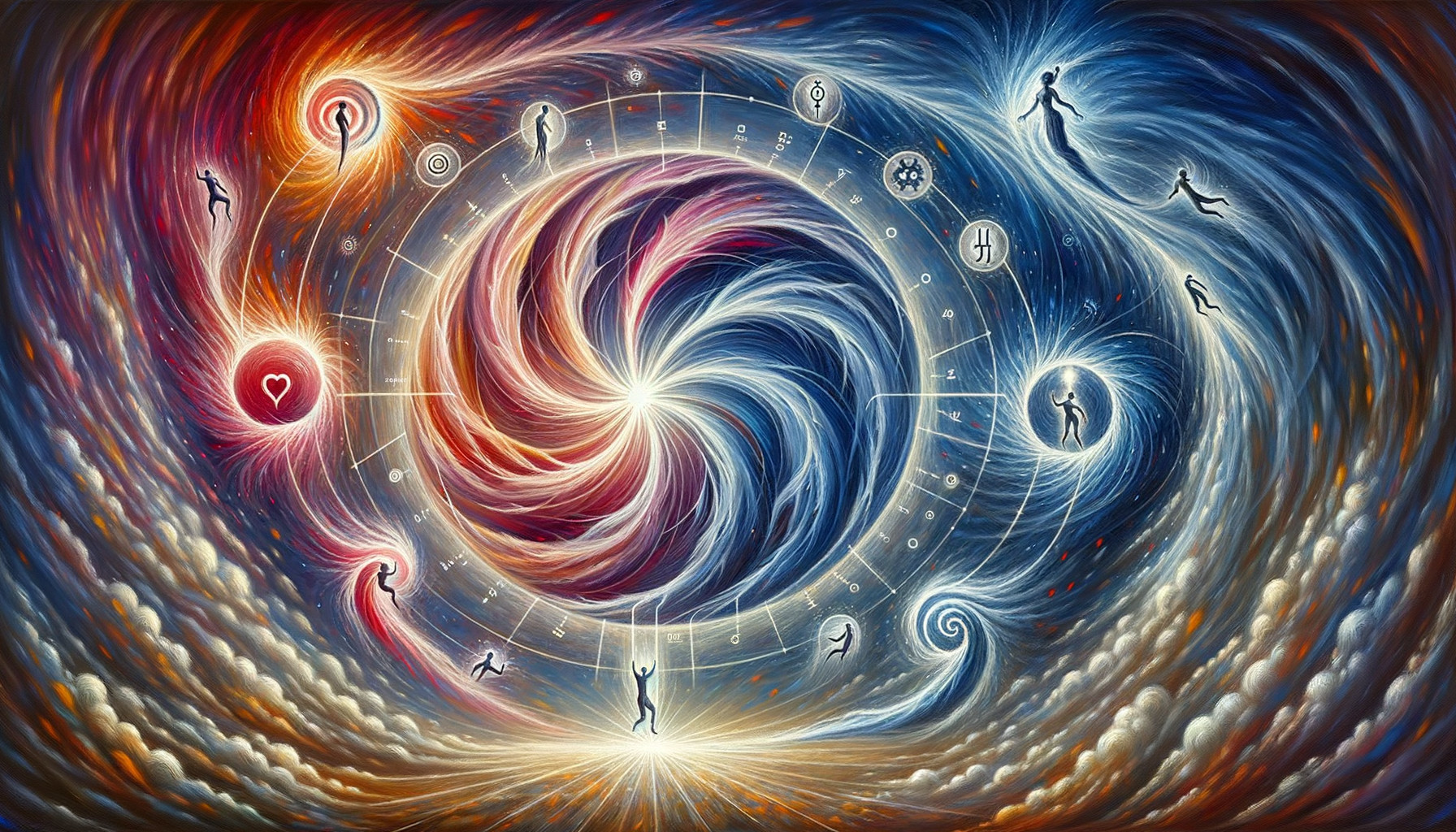
In an intricate dance of syntax and semantics, a C++ code weaves together the abstract notions of energy, karma, and the cyclical nature of life. This essay explores the depth of meaning encapsulated in the code and how C++ features not only facilitate but also mirror these philosophical concepts, creating a rich tapestry that blurs the lines between computing and existential contemplation.
The Essence of Energy
At the core of the narrative is the Energy class, a generic template that encapsulates the quintessential elements of love, fear, and death—emotions and states that drive the human experience. Through the lens of C++, templates are a powerful feature allowing for type abstraction and generality. Just as templates empower code with the flexibility to work across different data types, the concept of energy in the code transcends specific manifestations, embodying a universal principle applicable to various forms of existence.
Karma as Action and Reaction
The Karma class embodies the principle of actions and their consequences, a fundamental aspect of many philosophical and spiritual traditions. The class's methods, give and get, symbolize the cyclical nature of giving and receiving, actions and their repercussions. C++'s object-oriented programming (OOP) principles—encapsulation, abstraction, inheritance, and polymorphism—parallel these philosophical ideas. Encapsulation binds data and functions together, mirroring the inseparable nature of actions and their outcomes in karma. Abstraction allows for focusing on what actions are performed rather than how, akin to focusing on the essence of karma rather than its specific instances.
The Cycle of Life
The Life class represents the continuous cycle of existence, underscored by an infinite loop in the main function. This perpetual cycle is emblematic of the philosophical notion of Samsara, the endless cycle of birth, death, and rebirth. In C++, the infinite loop is a direct, literal representation of this cycle, showcasing the language's capability to model even the most abstract concepts in a concrete manner. The infinite loop, while simple, serves as a profound metaphor for the eternal, unceasing nature of life and existence.
Interconnections and Relationships
The relationships between the Energy, Karma, and Life classes illustrate another crucial aspect of C++ and object-oriented programming: the relationships and interactions between objects. The Life class's use of the Karma class, which in turn processes instances of the Energy class, reflects the interconnectedness of all things. This mirrors the concept of composition in OOP, where objects are composed of other objects, creating complex, interrelated systems.
The Echoes of Existence in Code
The code's use of standard input/output operations, classes, and control structures are C++ features that facilitate interaction with the user, embodying the code's interactive and reflective nature. The act of entering values and witnessing the resultant output serves as a meditation on the impact of one's actions and their ripple effects through the cycles of karma and life.
Conclusion
This C++ code, at its heart, is more than just a collection of classes, methods, and loops. It is a philosophical exploration, a meditation on the concepts of energy, karma, and the cyclical nature of existence. The features of C++—templates, OOP principles, and control structures—not only make this exploration possible but also reflect these concepts in their functionality and philosophy. Through this confluence of coding and contemplation, the code becomes a canvas, painting a picture of life's eternal cycles and the energies that drive them, inviting us to ponder our place within these cycles and the energies we choose to manifest.